Contents
By Rubén Darío Basay Roberts
Romanian adaptation and additional research: Comunica.md editorial team
We move the cursor, select a passage of text and open a document. These actions are so commonplace that we rarely ask who made them possible.
More than 6 decades ago, American researcher Douglas Engelbart was working on an ambitious idea: computers could become tools that help people organize information, collaborate and solve complex problems.
The mouse would become one part of this project.
A button and 2 wheels
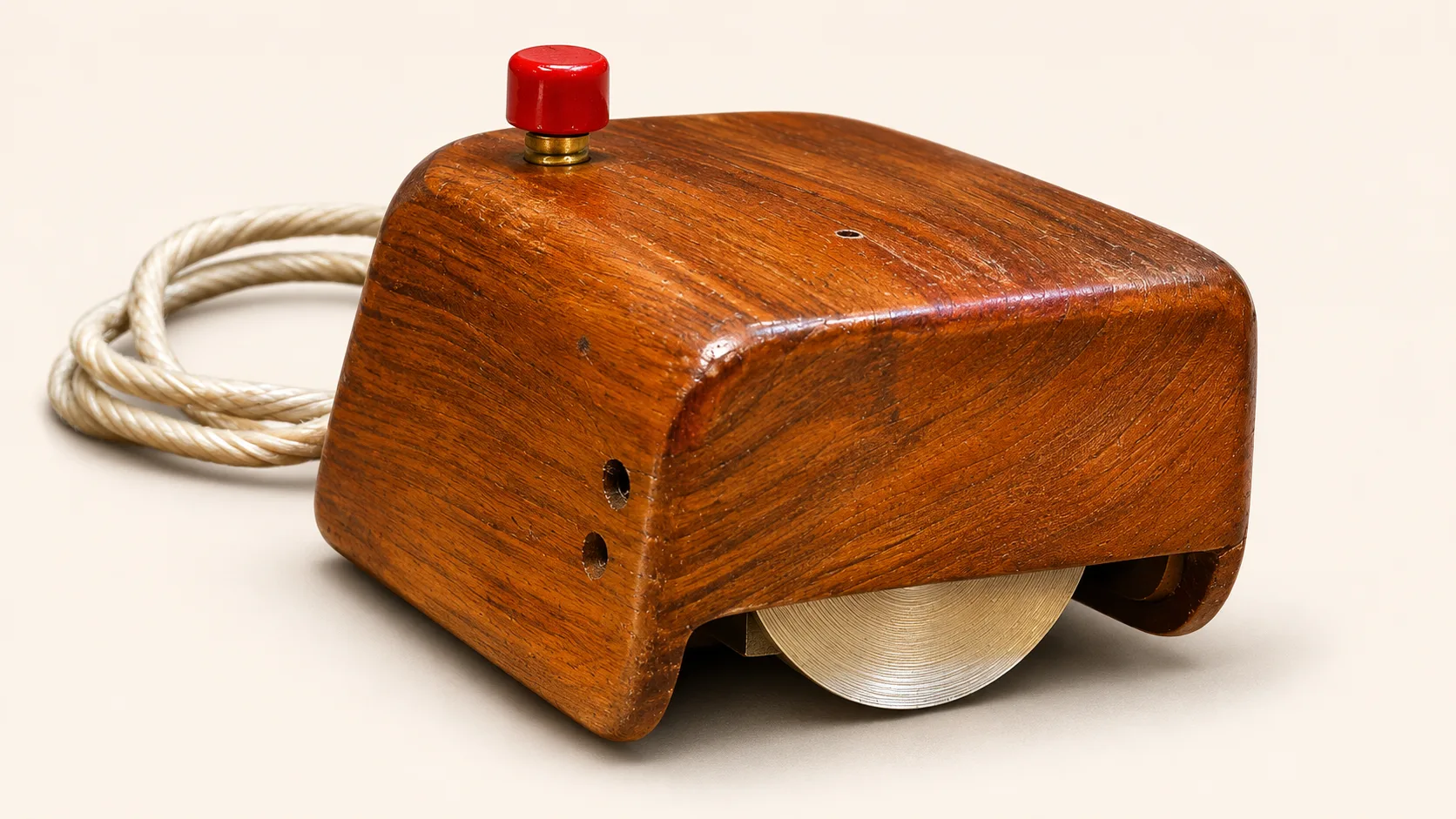
In 1964, at the Stanford Research Institute in California, the team Engelbart worked with, including engineer Bill English, built the first prototype: a wooden casing, a button and 2 wheels mounted at right angles.
Moving the device across a desk was translated into cursor movement on the screen. The wheels tracked the 2 directions, horizontal and vertical.
The cable looked like a tail, and the device was nicknamed “mouse”. The informal name would become better known than the technical name of the invention.
The patent came after the prototype
The patent application was filed on 21 June 1967. US patent number 3,541,541 was granted on 17 November 1970, with Douglas Engelbart named as the inventor and the Stanford Research Institute as the patent holder.
Its title described the mechanism: “X-Y Position Indicator for a Display System”. The 2026 anniversary therefore marks the patenting of the device, not its invention.
The demonstration that showed what was to come
On 9 December 1968, in San Francisco, Engelbart and his team publicly presented the NLS system in a demonstration lasting about 90 minutes.
They demonstrated interactive text editing, links between information and collaboration between people in different locations, with video and audio. The mouse controlled the cursor, but was part of a much broader set of tools.
The device used at the time was already a 3-button version, different from the first wooden prototype.
Why it still matters today
Viewed from the present, the story of the mouse says something about how we evaluate technology. The power of a system matters, but so does how easy it is for the person in front of the screen to use it.
A cursor that you move with your hand creates a simple link between intention and action. It does not, on its own, explain the evolution of computers, but it helps us understand one essential change: bringing digital tools closer to users’ gestures.
At a time when we are talking more and more about artificial intelligence and conversational interfaces, Engelbart’s question remains relevant: how do we build technology that helps people work and understand better?
Sources
- Google Patents / USPTO — US 3,541,541, X-Y position indicator for a display system (depus 21.06.1967, acordat 17.11.1970)
- Computer History Museum — The Mouse
- SRI International — The computer mouse and interactive computing
- Doug Engelbart Institute — Firsts: The Mouse
- Doug Engelbart Institute — Firsts: The Demo (9.12.1968, NLS, San Francisco)
Written with AI assistance from the official sources above and checked by the editors.
Newsletter
Moldova, in your inbox
The stories that matter, every morning, in a single email. You choose what you get and in which language.
- Free
- No spam
- One-click unsubscribe